Traditional OCR vs. AI Technology in Automating Order Processing
In many companies, order processing is highly repetitive, manual, and error-prone. Employees often spend countless hours on this tedious task instead of focusing on what matters most: their customers.
Updated on 1/9/2025
In many companies, order processing is highly repetitive, manual, and error-prone. Employees often spend countless hours on this tedious task instead of focusing on what matters most: their customers.
Fortunately, numerous solutions (with different technological approaches) are available to help companies automate order processing. In your search for the right automation solution (Top 7 Order Processing Automation Tools in 2024), you may have encountered terms like AI and OCR. Let's clarify their roles and capabilities.
While both OCR and AI offer significant benefits, pure OCR lacks the comprehensive capabilities needed for the complete automation of document processing in orders. OCR simply extracts structured data from documents. In contrast, AI goes beyond data extraction, enabling adaptive automation. AI can intelligently interpret unstructured data and integrate it with other applications post-extraction.
Let’s explore the differences between OCR and AI technology in order processing automation.
What is OCR in Order Processing?
Traditional Optical Character Recognition (OCR) is a technology designed to convert different types of documents, such as scanned paper documents, PDFs, or images, into editable and searchable data. Simply put, OCR digitizes the text on a document.
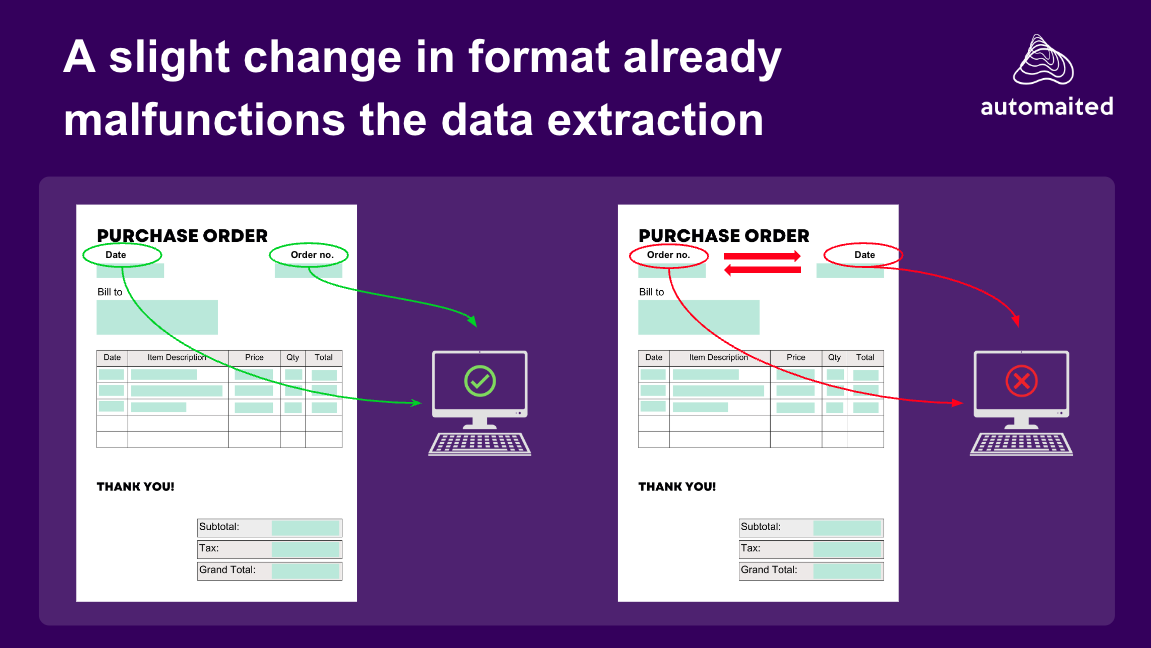
OCR recognizes characters in documents. However, for these characters and words to be useful in order processing, it is crucial to define what they represent. For example, does the text correspond to the buyer's company address, the delivery address, or the supplier's business address?
To do that, the user needs to define the exact location of the data, e.g., “The Customer Name always appears as the text here.” That sounds simple, but the problem arises when the location of that text changes, as the user needs to define the text and location again. Strict standard templates work well, but the user needs to redefine text and location from scratch every time for varying documents.
What is AI in Order Processing?
Artificial Intelligence (AI) combines a range of technologies that enable machines to mimic human intelligence, learn from data, and make decisions. In order processing, AI goes beyond simple text recognition to provide more advanced capabilities:
- Intelligent Data Extraction: AI extracts relevant data from complex and varied document formats, including handwritten text and unstructured data.
- Contextual Understanding: AI-powered systems can understand and interpret the context of the data, such as identifying customer names, order numbers, product details, and other key information.
- Continuous Learning: AI is always learning to get better. The more specific rules and needs you have for a document and the more feedback you provide, the better the output. AI systems improve over time through machine learning, adapting to new document types and improving accuracy with each processed order.
In conclusion, AI in order processing means that systems can now logically find and process relevant data, such as order and delivery dates, with greater efficiency. This logical thinking allows AI to handle a variety of data types and document formats seamlessly. Consequently, businesses benefit from enhanced accuracy, faster processing times, and the ability to adapt to diverse and complex order processing needs.
How to compare OCR with AI
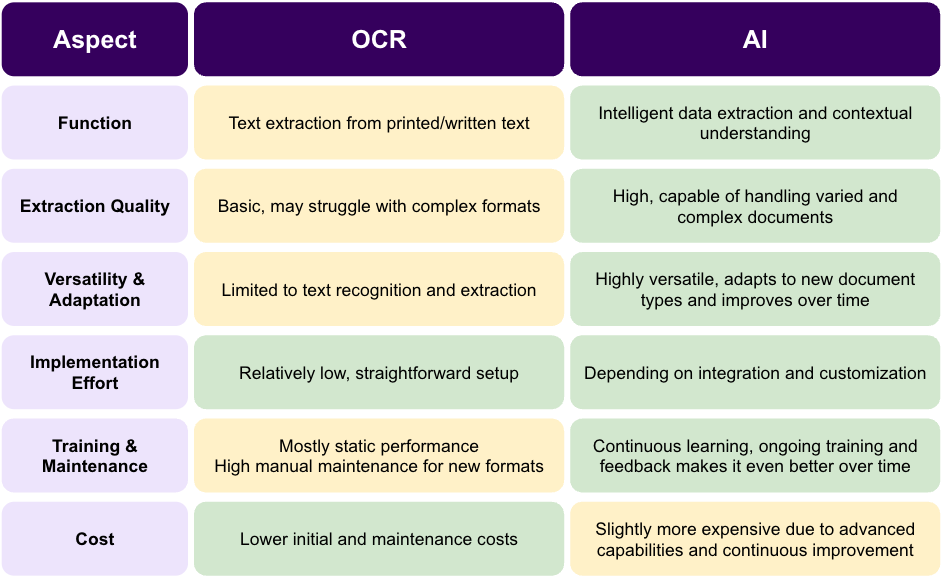
In order processing, OCR focuses on converting written or printed text into machine-readable data, handling straightforward text extraction tasks efficiently. In contrast, AI offers advanced capabilities such as intelligent data extraction, contextual understanding, and continuous learning, enabling it to manage complex documents and improve accuracy over time. While OCR is effective for basic text recognition, AI provides a more sophisticated and adaptive solution, making a direct 1:1 comparison difficult due to their differing levels of complexity and functionality in processing orders. The following comparison highlights their differing levels of complexity and functionality, underscoring the challenge of a direct comparison:
How automaited’s Order Processing Agent “Ada” is leveraging AI for your advantage
AI is not only used to extract data but also to manage and automate the whole order process:
- Quick Start with Limited Data: Ada starts to work with the first document and only needs a very little amount of document or data to provide high accuracy.
- Learning from Natural Language Feedback: Ada’s AI learns from your natural language feedback, eliminating the need for cumbersome document annotation or technical details.
- Improving Accuracy Over Time: Every inaccuracy in extraction has the potential to improve overall accuracy. Simply tell Ada what she did wrong and what she should have done. She will apply this knowledge intelligently to all future order documents.
- Handling Various File Formats: A wide range of file formats and data sources can be integrated with Ada, and she will handle them efficiently.
- Natural Language Communication: Ada will inform you in natural language if she is unsure about an extraction field. For example, “I extracted the delivery address X, but there was another address Y in the order that could also be the delivery address. Could you check if I made a mistake here?”
- Error Detection and Suggestions: Ada will make suggestions and point out potential mistakes your customer might have made. Again, in natural language: “Your customer ordered 5 items with the article number ‘MX43,’ but I think they meant ‘MX42’ based on the context. Can you check if they made a mistake?”
Conclusion
Both OCR and AI technologies have their place in order processing. OCR is a tool for converting printed text into digital form, only making it suitable for use cases with very few standard formats following a simple template. Still, for most use cases, OCR is reaching its limits very soon. AI offers more flexibility and is an adaptive solution in case of larger volumes of varying document types.